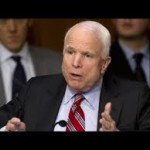
After tonight’s Republican debate, Rick Perry will be remembered not for what he said but what he couldn’t say.
“A Perry Moment” has officially become part of the national lexicon.
One by one, nearly every country in the Middle East has seen violent uprising by citizens eager to overthrow the existing government. Many Americans, driven perhaps by nostalgic thoughts about America’s own birth from violent revolution, have concluded that something beneficent was happening in the Libyan uprising.
Gadhafi is dead and Libyans are celebrating, but now comes the hard part. Attempting to establish democratic rule in a country that long suppressed individual freedoms will not be easy, given age old conflicts and disputes between the numerous feudal tribes that rule Libya.
Will Libya suddenly become an orderly, lawful and harmonious society now that Gadhafi is gone? Or will Libya descend into chaos, anarchy and civil war which will bring forth perhaps an even more oppressive government ruled by Islamic fundamentalists? The example of Egypt, for which so many had high hopes, suggests that Libya may also have a dark future.

Gadhafi In Better Times - courtesy navytimes.com
“I’m afraid the opposition is going to start fighting among themselves now,” said Michael Rubin, a senior lecturer at the Naval Postgraduate School and a former adviser to the Coalition Provisional Authority in Baghdad. “I’m afraid it’s going to be a far bloodier period in Libya.”
Libya has no experience with democracy, it is awash in arms and independent militias, and it is divided by geography and tribes. Islamic fundamentalists also pose a threat, and the new government could face resistance from Gadhafi loyalists who go underground.
“There is no unity, no consensus right now on what the future model of government in Libya should look like,” said Fawaz Gerges, director of the Middle East Center at the London School of Economics.
Conflict within the Libyan opposition already has begun, said Mansour El-Kikhia, a Libyan-born professor of politics at University of Texas at San Antonio who advised members of the Transitional National Council until about six weeks ago.
“It’s going to be very painful to come to terms with the vacuum Gadhafi has left,” El-Kikhia said. “The struggle for power will lead to the demise of the state. From what I’ve seen in the last month or so, I’m scared.”
Gadhafi had been a check on Islamic extremists in the region, and now those extremists are collecting the weapons Gadhafi stashed across the country.
“I don’t see anything resembling reconciliation right now,” Gelb said. “It is inevitable there will be more bloodshed.”
Democracy may be a noble tradition in the minds of Western scholars and politicians, but for Libya it is probably the most unworkable and destabilizing form of government possible.
Life is cheap in China and this video proves it. A two year old Chinese girl standing at the side of a street was callously run over by two separate vehicles and then ignored by 18 people who walked or drove by the severely injured child. Finally, a woman who collects trash for a living pulled the child from the street and called for medical help. Unfortunately, the child died the next day.
Even though the child was in full view of the first driver, notice how the van did not even attempt to slow down or swerve to avoid hitting the child. After the front wheels of the van ran over the child, the driver paused and then drove the rear wheels over the child. The driver of the vehicle fled the scene.
Even more astonishing, while the child lay severely injured in the street, a second car approaches and runs the child over again. This driver also made no attempt to brake his vehicle. The street shown in the surveillance video appeared more than wide enough for the second driver to avoid running over the child.
This video may be extremely disturbing to some people due to its graphic nature.
The video of the horrific incident has been widely publicized on Chinese blogs with wide ranging opinions about the lack of compassion shown by the indifferent drivers and passers-by. Whatever the reasons may be, the value of life in China is obviously cheap, especially for people at the lowest income levels of society who struggle to survive.
From my own experiences while in China, many of the people I have dealt with are arrogant, rude and more interested in making money than cultivating relationships. China’s economic growth for the past decade has been nothing short of phenomenal but China is still a great distance away from becoming a great nation.
As the U.S. economy continues its slow but steady march into economic depression, the Obama obsession with taxing millionaires and billionaires continues. Consider, Obama Tax Plan Would Ask More of Millonaires.
President Obama on Monday will call for a new minimum tax rate for individuals making more than $1 million a year to ensure that they pay at least the same percentage of their earnings as middle-income taxpayers, according to administration officials.
With a special joint Congressional committee starting work to reach a bipartisan budget deal by late November, the proposal adds a new and populist feature to Mr. Obama’s effort to raise the political pressure on Republicans to agree to higher revenues from the wealthy in return for Democrats’ support of future cuts from Medicaid.
Mr. Obama’s proposal is certain to draw opposition from Republicans, who have staunchly opposed raising taxes on the affluent because, they say, it would discourage investment. It could also invite scrutiny from some economists who have disputed Mr. Buffett’s assertion that the megarich pay a lower tax rate over all, because many in that group actually make more from wages than from investments.
In a speech on Thursday, Speaker John A. Boehner, Republican of Ohio, agreed with Mr. Obama that the deficit-reduction committee “can tackle tax reform, and it should,” to get rid of many tax breaks and allow for lower marginal rates. “Tax increases, however, are not a viable option for the joint committee,” Mr. Boehner said. Instead, he emphasized that meeting the deficit-reduction target should come largely from overhauling benefit programs like Medicare, Medicaid and Social Security.
The Obama proposal has little chance of becoming law unless Republican lawmakers bend. But by focusing on the wealthiest Americans, the president is sharpening the contrast between Republicans and Democrats with a theme he can carry into his bid for re-election in 2012.
Does the latest Obama tax proposal have merit or is it simply an attempt to capture votes based on a class warfare strategy? Half of all American households already pay zero income tax and the top 5% of Americans by income already pay 60% of all income taxes. As pointed out by the Wall Street Journal, there is No Easy Answer On Tax Issue.
“We’re approaching nearly half of the United States population that doesn’t pay any income taxes,” Mr. Perry said in Iowa, when asked about combating an “entitlement culture” in the U.S. “And I think one of the ways is to let everybody, as many people as possible…be able to be helping pay for the government that we have in this country.” In Nashua, N.H., Mr. Romney hit a similar theme: “We want to make sure people do pay their fair share.”
Of the poorest 20% of American households, those earning less than $16,812 a year, 93.4% pay no income tax. But even 30% of the middle class earning between $33,542 and $59,386 are exempt. Some Republican economists say the tax policies that cause this phenomenon have gone too far, contending that people who don’t pay income taxes have an incentive to support politicians who promise more federal programs, since they aren’t paying for them.
Moreover, they argue the tax code has become too dependent on too few people. Sixty percent of the income tax is paid by 5% of U.S. households, said Douglas Holtz-Eakin, a former Congressional Budget Office director who led domestic policy for John McCain’s 2008 campaign. “We’re going to have to have tax reform,” he said. “The system is broken.”
The U.S. tax code is a disgrace from every aspect but the odds of it being reformed by a deeply divided Congress are zero. Taxes on all income groups have been too low to cover massive government spending programs and the result is a debt crisis that threatens the solvency of the Nation. Our political leaders have promised unaffordable benefits to a vast array of constituents and paid for it by maxing out the Nation’s credit limits.
Ultimately, a solution to the Nation’s looming insolvency will require not only dramatic reductions of promised benefits but also large tax increases across all income levels.
The latest Rasmussen poll shows only a minuscule 6% approval rating of Congress by the American public, the worst approval rating on record. Skepticism runs wide and deep that Congress is able to improve the life of the average American. Only 9% of voters think Congress can make a positive difference and the latest outrageous example of Solyndra solar company should change the minds of this misguided 9% of the public.
The poll numbers indicate that what most Americans already know - the U.S. political system rules without the consent of the governed, and even worse, has consistently taken actions that work against the average American. Rasmussen polling shows that 43% of voters think that members of Congress are corrupt and an astounding 81% believe that members of Congress put their own interests ahead of the public.

Record levels of poverty and unemployment along with plunging income levels for those who still have jobs does nothing to deter Congress from continuing to funnel money to groups represented by corrupt lobbyists and special interest groups. The $535 million loss for taxpayers on loans given to solar company Solyndra was due to incompetence and insider dealing. Consider Obama Team Backed $535 Million solyndra Aid As Auditor Warned On Finances.
Solyndra LLC’s workers making solar-power panels in a California factory subsidized by U.S. taxpayers showed “the promise of clean energy isn’t just an article of faith,” President Barack Obama said on a visit to the company in May 2010.
Two months before Obama’s visit, accounting firm PricewaterhouseCoopers LLP warned that Solyndra, the recipient of $535 million in federal loan guarantees, had financial troubles deep enough to “raise substantial doubt about its ability to continue as a going concern.”
The Obama administration stood by Solyndra through the auditor’s warning, the abandonment of a planned initial public offering and a last-ditch refinancing where taxpayers took a back seat to new investors.
“People including our government put blinders on and did not want to believe in the obvious,” Jonathan Dorsheimer, an analyst in Boston for Canaccord Genuity Inc. of Vancouver, said in an interview with Bloomberg Government. “The fact that the government chose Solyndra as their white horse is mind- boggling.”
Days before filing for bankruptcy, Solyndra executives had the audacity to request additional money from the Energy Department but was turned down due to revelations by the media regarding questions of corruption and public waste. In addition, it was revealed that billionaire George Kaiser’s family trust controls 37% of Solyndra. Kaiser visited the President 16 times over the course of two years and has raised millions for the Obama campaign. Solyndra also spent $480,000 of taxpayer money lobbying Congress for more loans.
Kaiser risked nothing but if Solyndra had ever gone public, he would have made huge profits. Meanwhile, executives at Solyndra have an armful of excuses for their failure and have blamed everyone in sight, including Chinese solar companies.
Now that the Solyndra loans have become a public scandal, investigations and hearings were announced by the same villains in Congress who made the dubious loans to Solyndra to begin with. Given the circumstances, the only ones who might believe that justice will be done in this case are the 9% of misguided voters who still believe that Congress acts in the public’s best interests.