United State Postal Service Goes Postal On Rate Increases
Well, here they go again - another 2 cent or 4.5% increase in the cost of a first class stamp. The recent history of postal rate increases by the USPS has been on a sharp upward trajectory (courtesy: Wikipedia.org.)
| Date Introduced | Rate for first ounce (USD) | Additional ounces | Postcard rate |
|---|---|---|---|
| July 1, 2001 | .34 | .23 | .21 |
| June 30, 2002 | .37 | .23 | .23 |
| January 8, 2006 | .39 | .24 | .24 |
| May 14, 2007 | .41 | .17 | .26 |
| May 12, 2008 | .42 | .17 | .27 |
| May 11, 2009 | .44 | .17 | .28 |
In nine years since 2001, including the newly proposed rate increase, the cost of a stamp will have risen by 35.3%. Keep in mind that over the past nine years the inflation rate has remained subdued and personal income growth for those in the private sector has been virtually nonexistent.
In March of 2009, John Potter, head of the US Postal Service told Congress that the “Postal Service, which has served America for 234 years, is experiencing a very serious financial crisis because of the downturn in the economy. We are facing losses of historic proportions…our situation is critical”. Mr. Potter also noted that “the law constrains us from taking the businesslike actions necessary to fully and properly align our institutional cost base with reduced and evolving customer demand”.
Mr. Potter is correct that the Postal Service is not taking the proper “businesslike actions” but he is dead wrong in his assertion that the Postal Service financial crisis is due to the recession. The Postal Service is floundering because of it monopolistic position, excessive price increases for mediocre service, the relentless economics of the Internet and competition by well run private enterprises in the package delivery business.
Consider the following:
-Postal mail volume has seen a steep decline of 20% since 2000. Continuously raising prices as demand slumps will only increase USPS losses. Economics 101 Mr. Potter - demand falls as prices increase. Mail can be sent and bills paid on the Internet at a fraction of the price charged by the USPS - higher stamp prices will merely serve to increase use of the lower cost option.
-USPS lost $3.8 billion last year and expects to lose $7 billion this year. Additional rate increases to avoid losses will result in a vicious cycle of further reduction of volume for the Post Office, requiring additional rate increases.
-USPS Vice President Steve Kearney warned that the “The Postal Service faces a serious risk of financial insolvency”. Translation - we will be needing a taxpayer bailout sooner rather than later.
-This from the Wall Street Journal:
Most employees have no-layoff clauses, the starting salaries are about 25% to 30% higher than for comparably skilled private workers, and the fringe benefits are so expensive that the Government Accountability Office says $500 million a year could be saved merely by bringing health benefits into line with those of other federal workers.
The most overdue reform is to strip away the Post Service’s monopoly on first-class mail and bulk mail. Competition is the key ingredient to innovation, low prices and good service.
No private business in America could continually raise prices, lose billions of dollars and then hope to win back customers by promising poorer service.
-As the Post Office continues to furiously raise prices, both volume and revenue continue to plunge, as can be seen by the following figures from the USPS. The latest large proposed rate increase tells us that the Post Office has truly gone “Postal” - repeating the same act again and again and expecting a different result.
The Postal Service has not changed with the times, plodding along like it was still the 1950’s. Attempted organizational changes and cost cutting measures have failed. Raising rates further is the most self destructive action that the Post Office could possible take. The Postal Service needs to be dramatically restructured and reduced in size to reflect the basic economic reality of its core business. Congress should cut the Post Office loose from self defeating regulations of a by gone era, let them operate as a business and close the door on taxpayer bailouts and subsidies.
Obama Says We Can Do With Health Care What We Did With The Post Office
Why The Post Office Needs To Charge Us More
Postal Service Poor Analogy
Now we know why the President usually does not say much without the Teleprompter in front of him; why in the world would you mention the Post Office when trying to convince America that the government should take over the health care system?
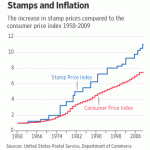
The Post Office is a prime example of how a lack of competition leads to high prices. Without competition, there is no need to worry about raising prices, providing good service or running an efficient organization - higher prices are simply passed on to the consumer. Productivity has been growing in the private sector for decades, especially with the efficiencies gained through the Internet. Yet year after year, the Post Office relentlessly raises rates far in excess of the consumer price index.

Cost Of A Stamp
Consider some of the other obnoxious results of a government run monopoly as detailed in a recent Wall Street Journal Opinion column:
Whatever possessed President Obama to mention the travails of the post office while discussing health care the other day, his timing was certainly apt. The Postal Service is headed toward a loss of $7 billion this year and another $7 billion in 2010.
Most mail today is delivered electronically via email. Traditional postal mail volume has fallen by nearly 20% since 2000, and the average household gets one-third fewer letters than a decade ago.
No private business in America could continually raise prices, lose billions of dollars and then hope to win back customers by promising poorer service.
Here’s a secret Washington doesn’t want to admit: That 14 cent per letter cost hike after inflation over the past 60 years imposes a $20 billion a year toll on the U.S. economy.
Most employees have no-layoff clauses, the starting salaries are about 25% to 30% higher than for comparably skilled private workers, and the fringe benefits are so expensive that the Government Accountability Office says $500 million a year could be saved merely by bringing health benefits into line with those of other federal workers.
The most overdue reform is to strip away the Post Service’s monopoly on first-class mail and bulk mail. Competition is the key ingredient to innovation, low prices and good service. This was Mr. Obama’s insight at his recent health-care town hall when he noted that “UPS and FedEx are doing just fine, right? No, they are. It’s the Post Office that’s always having problems.”
The argument has been made for 200 years that the postal monopoly is necessary to “bind the nation together.” Once that was at least plausible. But today the Internet delivers to the most remote corners of Alaska and the Badlands at one-one-hundredth the cost of snail mail. The sooner Congress requires the Postal Service to shrink and adapt to this reality, the smaller will be the losses imposed on taxpayers.
To expect a government health care monopoly to be run efficiently defies common sense and the American public knows it. The attempt to quickly ramrod massive health care legislation into law before allowing public discussion is an outrage against democracy.
The haste to force health care legislation upon the American public implies that those pushing for “quick” legislation knew that in the light of day, the American public would reject it or demand further information on the cost/benefits of proposed changes. Elected representatives are supposed to represent the public view rather than arrogantly assume that they know what is best. The uncontrollable, unaccountable and free spending mob now running the country needs a course in basic democracy.
From The “Hard to Believe” Files
How does a postal employee steal $600,000 worth of stamps over a period of 10 years without the Post Office noticing that it’s stamps are missing??
Postal Clerk Admits $600,000 Stamp Theft
A Howard County postal clerk pilfered more than $600,000 worth of stamps, many of which were sold on eBay at a reduced price, federal authorities said.
Marvin L. Foster, 55, of Rosedale, who worked as a clerk at the Elkridge post office for a decade, pleaded guilty Thursday in U.S. District Court in Baltimore to conspiracy to steal from the U.S. Postal Service.
According to the U.S. attorney’s office for Maryland, Foster stole the stamps and then sold them to others for a profit. One of his alleged co-conspirators sold more than $259,000 worth of stamps on eBay for about $229,000, authorities said.
Foster was caught on hidden camera several times in December as he sneaked into the post office supply room and rifled through boxes of “forever” stamps, according to court documents. The stamps, which never expire, come in bricks of 2,000 stamps worth $840 as well as coils of 100 stamps that cost $42.
Certain questions, not covered in the Washington Post story, really need to be answered by the involved parties in this theft.
The Postal Service has seen a severe decline in business due to the growth of email and on line bill payment services, etc. which obviate the need for physical mail delivery. Instead of downsizing or becoming more efficient as volume declines, the Post Office solution has been to continuously raise rates which, of course, is self defeating. That the Postal Service is in dire need of restructuring seems obvious to many - what is not obvious is why it hasn’t been done.