Public Angst Grows

Recent polls indicate increasing disaffection with the economic and social policies being forced upon the American public by the controllers in Washington.   The American public thought that they voted for “change” but what we seem to be getting is micro management and obtrusive government interference into our  lives.

The imperial Washington power structure seems oblivious to the fact that most Americans do not trust their government and believe that their financial situation is being made worse, not better, by government policies.

Here are the results from the latest polls that are beginning to show a major disconnect between the average American and an out of control power elite in Washington who believe they know “what is best for us”.

Why Obama’s Ratings Are Sinking

Instead, Gallup reports that disapproval of the president’s economic policies has grown to 49% in July from 30% in February. Even among the president’s core supporters, young people in the 18-29 age group, his overall approval has dropped 11 points since January.

Dissatisfaction is spreading into open protest as members of Congress try to explain the president’s policies to the public. Angry voters have engaged in high-profile confrontations in town-hall meetings around the country over a proposed health-care overhaul that protesters complain is unaffordable, socialistic, incomprehensible, and which their representatives have not even read.

The president’s sinking approval ratings are due precisely to his administration’s free-spending ways. In a July 2009 Gallup poll, the No. 1 reason for disapproval of the president’s economic policies was, literally, “spending too much.” In second place was the worry that the president is “leading the nation toward socialism” through government takeovers and bailouts.

In January 2009, the Pew Research Center asked about 2,000 Americans, “Do you think the government does more to help or more to hurt people trying to move up the economic ladder?” Amid the most frightening economic crisis in decades, more Americans still said the government would hurt than the number who thought it would help (50% versus 39%). Independent surveys from roughly the same period found that only one in five Americans believed he or she could trust the government.

Citizens will put up with a lot—but not with anyone who imperils our future.

There is no evidence that more than a minority of Americans accept the idea that a $17 trillion national debt, greater reliance on government for jobs and health, and hyper-progressive taxation offer the hope they deserve for themselves and their children. The administration and Congress can deny these truths with charges of un-Americanism and implausible conspiracy theories about the current citizen demonstrations. But opinion polls deliver an honest expression of unhappiness over the direction our nation is taking.

The ruling elite in Washington seem to be oblivious to or ignoring the reality of America’s growing disaffection with the course the nation is taking.  The approval rating of Congress is at 30%.  Only one if five Americans trust their government.   Many Americans believe that government policies are financially bankrupting the country and the future of our children.   It’s almost as if our country was being run by overlords, appointed by a foreign power.  It’s time for change indeed - the problem is that the “changes” being forced upon us are not quite what we had in mind.

(0) Comments    Read More   

Postal Service Poor Analogy

Now we know why the President usually does not say much without the Teleprompter in front of him; why in the world would you mention the Post Office when trying to convince America that the government should take over the health care system?

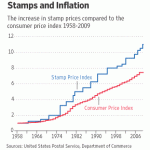
The Post Office is a prime example of how a lack of competition leads to high prices.  Without competition, there is no need to worry about raising prices, providing good service or running an efficient organization - higher prices are simply passed on to the consumer.   Productivity has been growing in the private sector for decades, especially with the efficiencies gained through the Internet.  Yet year after year, the Post Office relentlessly raises rates far in excess of the consumer price index.

Cost Of A Stamp

Cost Of A Stamp

Consider some of the other obnoxious results of a government run monopoly as detailed in a recent Wall Street Journal Opinion column:

Whatever possessed President Obama to mention the travails of the post office while discussing health care the other day, his timing was certainly apt. The Postal Service is headed toward a loss of $7 billion this year and another $7 billion in 2010.

Most mail today is delivered electronically via email. Traditional postal mail volume has fallen by nearly 20% since 2000, and the average household gets one-third fewer letters than a decade ago.

No private business in America could continually raise prices, lose billions of dollars and then hope to win back customers by promising poorer service.

Here’s a secret Washington doesn’t want to admit: That 14 cent per letter cost hike after inflation over the past 60 years imposes a $20 billion a year toll on the U.S. economy.

Most employees have no-layoff clauses, the starting salaries are about 25% to 30% higher than for comparably skilled private workers, and the fringe benefits are so expensive that the Government Accountability Office says $500 million a year could be saved merely by bringing health benefits into line with those of other federal workers.

The most overdue reform is to strip away the Post Service’s monopoly on first-class mail and bulk mail. Competition is the key ingredient to innovation, low prices and good service. This was Mr. Obama’s insight at his recent health-care town hall when he noted that “UPS and FedEx are doing just fine, right? No, they are. It’s the Post Office that’s always having problems.”

The argument has been made for 200 years that the postal monopoly is necessary to “bind the nation together.” Once that was at least plausible. But today the Internet delivers to the most remote corners of Alaska and the Badlands at one-one-hundredth the cost of snail mail. The sooner Congress requires the Postal Service to shrink and adapt to this reality, the smaller will be the losses imposed on taxpayers.

To expect a government health care monopoly to be run efficiently defies common sense and the American public knows it.  The attempt to quickly ramrod massive health care legislation into law before allowing public discussion is an outrage against democracy.

The haste to force health care legislation upon the American public implies that those pushing for  “quick” legislation knew that in the light of day, the American public would reject it or demand further information on the cost/benefits of proposed changes.  Elected representatives are supposed to represent the public view rather than arrogantly assume that they know what is best.  The uncontrollable, unaccountable  and free spending mob now running the country needs a course in basic democracy.

(1) Comment    Read More   

Congress and the Obama administration continue to move forward with economy killing legislation such as  Cap & Trade, Health Care Reform and  Card Check legislation,  to name a few.  The gorilla in the room that no one wants to talk about is the massive deficit being forced on future generations.

BROKE-BANK MOUNTAIN OF DEBT

The way Michael Whalen of the National Center for Policy Analysis figures it, the na­tional debt is $11 trillion, but there’s also $107 trillion in unfunded entitlement liabilities for a total of $118 trillion, more than eight times the gross domestic product. More ominously, the Federal Re­serve Board says federal liabilities are 2.3 times America’s total pri­vate net, which is just $51.5 trillion. “Ask any accountant, banker, or anyone remotely familiar with simple accounting knowledge if we can service this debt, and the collective answer is a resounding ‘no.’ Any business with these ratios would be a complete basket case, hopelessly bankrupt.” Hence, the headline on Mr. Whalen’s Wash­ington Times op-ed Aug. 11: “We broke the bank.”

This is by far the greatest problem that our country will be facing, assuming that our economy and country can survive this onslaught of Socialist Programs. How much of the Federal Budget can be spent on debt repayment as our economy continues to shrink?

In other words….”I’m sorry Mr Geithner , based on your current situation, we can not approve your loan at this time. Feel free to visit Beijing again when your situation improves”.

We Broke The Bank

The United States is functionally bankrupt. Our collective capacity to deal with this astonishing fact is seemingly nonexistent. Our national politics have become show business, exhibiting a complete refusal to strategically respond to this reality.

Even if we significantly slash the federal entitlements by half, we cannot fix this problem. Even if we increase federal receipts from the 50 year average of 18 1/2 percent of GDP to say 27 percent, killing private-sector growth, we cannot fix the problem.

Perhaps President Obama is planning on a fast track bankruptcy for the federal government, just as he did for General Motors and Chrysler. The result would be SEIU (Service Employees International Union) making the decisions for Congress and ACORN running the Treasury.

(0) Comments    Read More   

Clinton Needs A New Spin Master

Portraying Clinton’s African safari as a “success” will forever reign as the most unbelievable spin job in history.  It would have been far better to say nothing than to bring more publicity to what was a disastrous trip.  Besides being sent on a meaningless journey to countries that most Americans never heard of, Clinton had to put up with insulting questions from her hosts as well as being publicly upstaged by her own husband.

Here’s the official spin job - believe it or not!

Clinton’s Africa Trip Is Viewed as a Success

Secretary of State Hillary Clinton apparently accomplished what she set out to do on her trip to Africa. She pressed governments from Kenya to Nigeria to Libera for reform.

She highlighted the plight of women in Congo, meeting with rape victims and hearing their stories.

But the trip did not go entirely as planned.

Media headlines instead focused on Clinton’s more controversial remarks on tangential issues, and America’s top diplomat found herself commenting more on someone who was not even there: her husband, former President Bill Clinton.

As Secretary Clinton embarked on the 11-day, seven-country swing through the continent, President Clinton departed for North Korea on what was described by officials as a “humanitarian” mission to retrieve two American journalists being held there.

President Clinton’s successful trip was a media coup, one that overshadowed his wife’s arrival in Africa. In interviews and press conferences soon after her arrival, reporters peppered her for information about her husband’s trip as the rescue dominated headlines around the world.

The comments, and video, ricocheted around the world, prompting commentators and analysts to wonder if the secretary was withering under her husband’s shadow. She had just spent the past month fighting rumors of her marginalization in the Obama administration while nursing a broken elbow.

At a town hall event in Abuja, Nigeria, she compared the 2000 U.S. election Florida recount to the allegedly rigged election in Nigeria.

The comparison drew sharp criticism from conservatives in Washington, who balked at the notion that Clinton would compare a United States election to one in Nigeria marred with missing ballot boxes, inflated voter counts, and shooting of voters at polling stations. Again, the headlines were concerned less with governance in Nigeria and more with whether Clinton made yet another misstep.

Perhaps if Hillary had simply brought Bill Clinton along with her, the trip might have been a real “success”.

(1) Comment    Read More   

Hillary’s Meaningless Journey

After embarking on a largely symbolic trip to Africa, Hillary reached the breaking point as her African trip was marginalized by her own husband’s trip to North Korea.

Clinton’s Cross To Bear

It has to be Hillary Rodham Clinton’s worst nightmare. After missing her big chance to become president, she becomes secretary of state — arguably the most powerful woman in the world — and still, she’s living in her superstar husband’s shadow.

David Rothkopf, a foreign policy expert and author who served in the Clinton administration, says the secretary’s frustrated reaction — “My husband is not the secretary of state; I am” — was the breaking point for a woman who has been largely overshadowed throughout the first six months of President Obama’s administration.

Even as Clinton has been doing the tough talking to such international menaces as North Korea and Iran, playing bad cop to Obama’s good cop, she has done so in relative obscurity, given her star stature. The media coverage of Clinton’s tenure as secretary of state has focused more on her personality rather than on her work as international peacemaker and dealmaker, Rothkopf notes.

“Hillary gets People magazine treatment,” he says. “It must be frustrating for her.”

Clinton was visibly angry when a student at a town hall meeting in the Democratic Republic of Congo asked her, referring to a Chinese economic development contract with Congo, “What does Mr. Clinton think, through the mouth of Mrs. Clinton?”

“Wait, you want me to tell you what my husband thinks? My husband is not the secretary of state; I am,” Clinton replied, seething. “You ask my opinion, I will tell you my opinion. I’m not going to be channeling my husband.”

Mistranslated or not, the suggestion that Mr. Clinton’s opinion mattered more than Secretary Clinton’s was the final straw in what apparently has been an escalating source of frustration for her. As Rothkopf says, “It’s tough being the most powerful woman in the world.”

How Obama Neutered Hillary

The Secretary of State may be starting to realize that she is on the losing end of a brilliant strategy by the President to contain and marginalize her as a future political opponent.  Clinton has been involved in no matters of substance as  Secretary of State.  Although bravely trying to portray the African trip as being important, it was largely irrelevant.   For the President to send her husband on a high publicity trip to North Korea as she was trudging through a meaningless African safari was the final breaking point for Hillary.  Why would the President send Bill Clinton to North Korea instead of his Secretary of State??  The obvious message to Hillary was hard to miss.

As a senator from New York, Clinton could have had major input and influence on the serious domestic issues affecting the Country.   By convincing Hillary to become Secretary of State, the President has effectively removed her from domestic issues.  The vast majority of Americans would not even be able to identify what continent the countries she visited are located on.   The vast majority of voters are more concerned about domestic issues than foreign policy.   Clinton’s official role precludes her from being directly involved in issues that matter most to voters.   The question at this point is what can Hillary do about it?

(0) Comments    Read More